
Link
Markdown links, reference links and automatic links — and what happens when one is tapped.
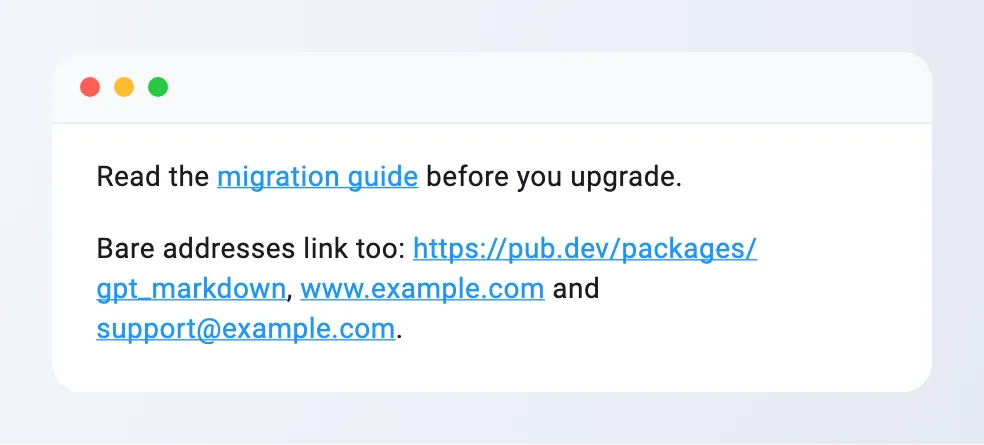
Read the [migration guide](https://pub.dev/packages/gpt_markdown "Upgrading to 1.4") before you upgrade.
Bare addresses link too: https://pub.dev/packages/gpt_markdown, www.example.com and [email protected].
Syntax
Section titled “Syntax”[label](url "title"), [label](<url with spaces>), and reference links
[label][ref] with a [ref]: url line. Bare URLs, www. hosts, email
addresses and <https://…> are linked automatically —
inline syntax covers schemes and turning it off.
Links do nothing on their own: the package does not depend on a URL launcher, so opening one is your decision.
GptMarkdown( reply, onLinkTap: (url, title) => launchUrlString(url),)Styling
Section titled “Styling”styleSheet: const GptMarkdownStyleSheet( link: LinkStyle( color: Color(0xFF0B57D0), hoverColor: Color(0xFF0842A0), decoration: TextDecoration.none, fontWeight: FontWeight.w500, ),),GptMarkdown(text, onLinkTap: (url, title) => launchUrlString(url))title is the label text, which is useful for confirmation dialogs:
onLinkTap: (url, title) async { final ok = await confirm('Open "$title"?\n$url'); if (ok) await launchUrlString(url);},API reference
Section titled “API reference”LinkStyle
Section titled “LinkStyle”How a link is drawn.
Set it as GptMarkdownStyleSheet(link: LinkStyle(…)) on the widget, or in GptMarkdownThemeData for the whole app. Every field is optional; an unset one falls back to the theme, then to the default.
| Field | Type | Description |
|---|---|---|
color |
Color? |
Link colour. Defaults to the theme’s linkColor. |
hoverColor |
Color? |
Colour under the pointer. Defaults to linkHoverColor. |
decoration |
TextDecoration? |
Defaults to an underline. |
decorationThickness |
double? |
Underline thickness. Defaults to the font’s. |
fontWeight |
FontWeight? |
Weight of link text. Defaults to the surrounding weight. |
| Member | Type | Description |
|---|---|---|
merge(LinkStyle? other) |
LinkStyle |
This style, with any unset field taken from other, field by field. |
resolve(ColorScheme scheme) |
LinkStyle |
This style with every remaining default filled in. |
copyWith({…}) |
LinkStyle |
A copy with the given fields replaced. |
static lerp(LinkStyle? a, LinkStyle? b, double t) |
LinkStyle? |
Linearly interpolates between two styles. |
resolve: more
Colours fall back to the theme’s linkColor and linkHoverColor, which
remain the app-wide way to set them.
inlineLinkBuilder
Section titled “inlineLinkBuilder”Builds the span for a link, replacing the default rendering.
Wins over linkBuilder when both are set. Returning a span rather
than a widget keeps the link on the text baseline, wrapping across
lines and selectable — none of which a WidgetSpan can do.
typedef InlineLinkBuilder = InlineSpan Function(LinkBuildDetails details);onLinkTap
Section titled “onLinkTap”The callback function to handle link clicks.
void Function(String url, String title)? onLinkTapautolink
Section titled “autolink”Whether bare URLs, www. hosts, email addresses and <...> autolinks
become links. Defaults to true.
Bare autolinks follow the GFM autolink extension; <...> autolinks follow
CommonMark §6.5. Turn this off to render URLs as plain text — for
untrusted input where an accidental tap target is unwelcome.
bool autolinkautolinkSchemes
Section titled “autolinkSchemes”Extra URL schemes linked without <>.
http, https, mailto and xmpp are always linked. Anything else has
to be opted into, because a bare foo://bar in prose is usually not meant
as a link:
GptMarkdown(text, autolinkSchemes: const {'myapp'})This does not affect <...> autolinks, which accept any scheme as
CommonMark specifies — the author wrote the brackets deliberately.
Set<String> autolinkSchemesfollowLinkColor
Section titled “followLinkColor”Whether to follow the link color.
bool followLinkColorlinkBuilder
Section titled “linkBuilder”Builds a widget for a link.
Used only when inlineLinkBuilder is null. The result is wrapped in a
WidgetSpan, which is the shape that made this hook a problem —
prefer inlineLinkBuilder, or styleSheet’s LinkStyle when you
only want to restyle.
typedef LinkBuilder = Widget Function( BuildContext context, InlineSpan text, String url, TextStyle style,);LinkBuildDetails
Section titled “LinkBuildDetails”What the link builder is told about one [label](url) or autolink.
| Member | Type | Description |
|---|---|---|
context |
BuildContext |
The element this construct is being built in. |
config |
GptMarkdownConfig |
The configuration in force at this point in the document. |
style |
TextStyle |
The text style in effect for this construct, fully resolved. |
url |
String |
The link target — /docs/a, https://x.dev, mailto:[email protected]. As written, except that backslash escapes and entity references are decoded (CommonMark), and a reference link ([text][label]) carries the URL of its [label]: url definition. Never otherwise resolved or normalised. |
label |
String |
The label as plain text. |
labelSpans |
List<InlineSpan> |
The label, already parsed and styled with style. |
linkStyle |
LinkStyle |
The resolved LinkStyle — colour, hover colour, decoration, thickness and weight, with GptMarkdownTheme fallbacks already applied. |
isAutolink |
bool |
Whether the package found this as a bare URL rather than as […](…). |
onTap |
VoidCallback? |
Invokes GptMarkdownConfig.onLinkTap for this link, or null when no handler is set. |
hoverStyle |
TextStyle |
style recoloured with LinkStyle.hoverColor, for TappableTextSpan.hoverStyle. |
defaultSpan({TextStyle? style, List<InlineSpan>? children}) |
InlineSpan |
Exactly what a link renders as when no builder is given. |
asWidgetSpan(…) |
InlineSpan |
child in a placeholder wrapped exactly the way the deprecated LinkBuilder’s result is, with onTap attached. |
config: more
Read GptMarkdownConfig.scope from it to tell a link in a table cell
from one in ordinary content, and GptMarkdownConfig.textDirection or
GptMarkdownConfig.textScaler when a widget of your own needs them.
TableBuilder and OrderedListBuilder already take a whole config for
the same reason.
style: more
A builder never has to guess a default: this is what the construct would have been drawn with, its own style already applied over the surrounding one.
label: more
This is what GptMarkdownConfig.onLinkTap receives as its second
argument. For an autolink it is the URL itself. It is not a link
title: the parser reads [text](url "title") titles into MdLink.title,
but they do not reach builders yet.
labelSpans: more
The parse has happened by the time a builder runs, in the
MarkdownScope.linkLabel scope, so [**bold** link](url) arrives as the
spans that render it. An autolink’s label is one plain run, deliberately:
re-parsing a URL would let ItalicMd eat the underscores out of
https://example.com/a_b_c.
linkStyle: more
Passed alongside style so a builder can reach a value a TextStyle
cannot carry. hoverColor is the one that exists today.
onTap: more
Hand it to TappableTextSpan.onTap — or to defaultSpan, which does it
for you — rather than calling onLinkTap yourself, so the arguments stay
right when they change.
defaultSpan: more
Returning this from InlineLinkBuilder is a no-op, which makes it the
safe starting point: keep it, then change one thing.
style replaces the style on the container span. It does not
restyle the label, because labelSpans were already built with their own
styles — bold inside a link stays bold, and a colour set here does not
reach them. To recolour the label, rebuild it and pass children:
inlineLinkBuilder: (link) => link.defaultSpan( children: [TextSpan(text: link.label, style: link.style.copyWith( color: link.url.startsWith('https://') ? null : Colors.orange, ))],),For a widget instead of a span, see asWidgetSpan.
asWidgetSpan: more
The escape hatch for a link that genuinely has to be a widget. It cannot wrap across lines, is skipped by text selection, is one opaque character to the streaming reveal, and does not paint on iOS when nested inside another placeholder — prefer a span where the design allows.